Focusrite Scarlett 2i2 Studio 4th Gen Review: The New Studio Standard or Just Marketing Noise?

The Heartbreak of the "Almost" Great Take
You’ve been there. It’s 2:00 AM. The house is silent, the inspiration is finally hitting, and you just laid down the vocal performance of your life. Your hair is standing up. You go to hit play, ready to bask in the glory of your future hit, and then you hear it.
Hiss. A thin, digital veil of noise suffocating your emotion. Or worse—the chorus hit, you got passionate, and the waveform looks like it was shaved off with a lawnmower. Clipped. Ruined. In 1997, we called that "the death of a vibe." Back then, avoiding that meant spending $5,000 on a rack-mounted preamp and a Tascam tape machine that weighed as much as a small car.
Today, Focusrite tells you that you can solve all those heartaches with a red box that fits in your laptop bag. But is the Focusrite Scarlett 2i2 Studio 4th Gen actually the "RedNet for the masses" they claim it is, or is it just another shiny entry-level toy designed to sell you the dream of a studio without the reality of the performance? I’ve spent 30 years in the trenches, from ADAT tape to M3 Max chips. I don't care about the marketing. I care about the signal.
Let's see if this red box earns its spot on your desk.
The Bottom Line (TL;DR)
Best For: Solo artists, songwriters, and podcasters who need high-headroom preamps and "set it and forget it" levels.
Performance Score: 8.8 / 10
MSRP/Street Price: $329.99 (Studio Bundle) (Amazon Sponsored Link)
The Final Verdict: The 4th Gen isn't just a face-lift; it’s a total internal overhaul. The converters and the 69dB gain range finally bring the 2i2 into the "serious tool" category, even if the included headphones are just "fine."
Build Quality: Does it Survive the "1997 Torture Test"?
As an Amazon Associate I earn from qualifying purchases.
Back in '97, we built studios with gear that could double as a blunt force weapon. The old ISA 110s? Tanks. The first time I held a 1st Gen Scarlett years ago, I laughed. It felt like a toy.
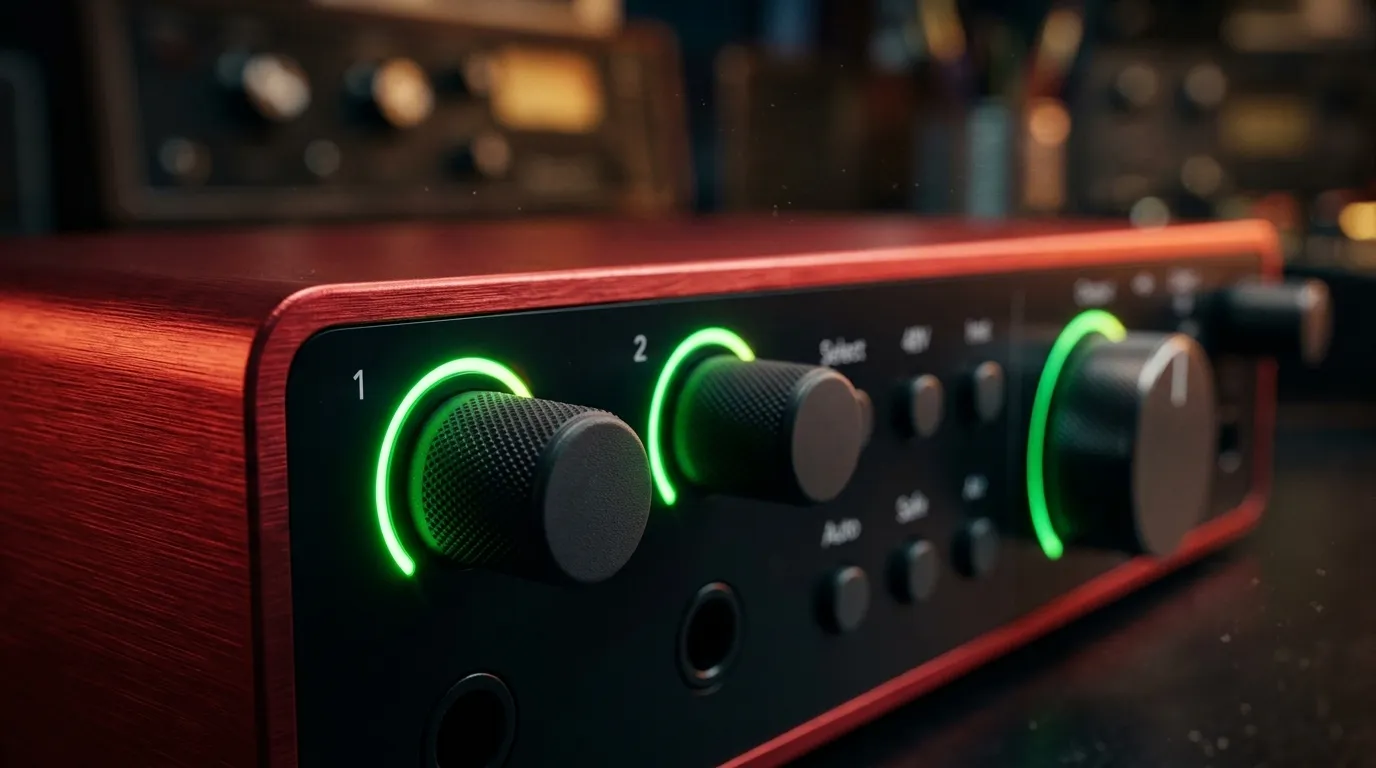
The 4th Gen 2i2, however, has finally hit its "adult" phase. The chassis is a solid, extruded aluminum shell. It has weight. It stays where you put it on the desk instead of being dragged off by the weight of your XLR cables. But let’s talk about the tactile experience.
The knobs have a distinct, viscous resistance. They don't "wiggle" like the cheap plastic pots on some budget interfaces I won't name (cough, Behringer). The gain halos have been redesigned; they aren't just "on or off" anymore. They act as actual meters now. This is a massive workflow win.
Thermal Reality Check: I ran this unit for 10 hours straight in a session tracking acoustic guitars and vocals. It gets warm—specifically near the converter chip—but it doesn't "cook." It’s stable. In the 90s, we had to leave space in the rack for gear to breathe; this little box manages its heat well enough to live under a monitor stand without melting.
Technical Performance: The "Meat" of the Signal
As an Amazon Associate I earn from qualifying purchases.
Let’s get into the hard data because, at the end of the day, your audio interface is the gateway to your DAW. If the gate is narrow, your sound is small.
The Converters (The Star of the Show)
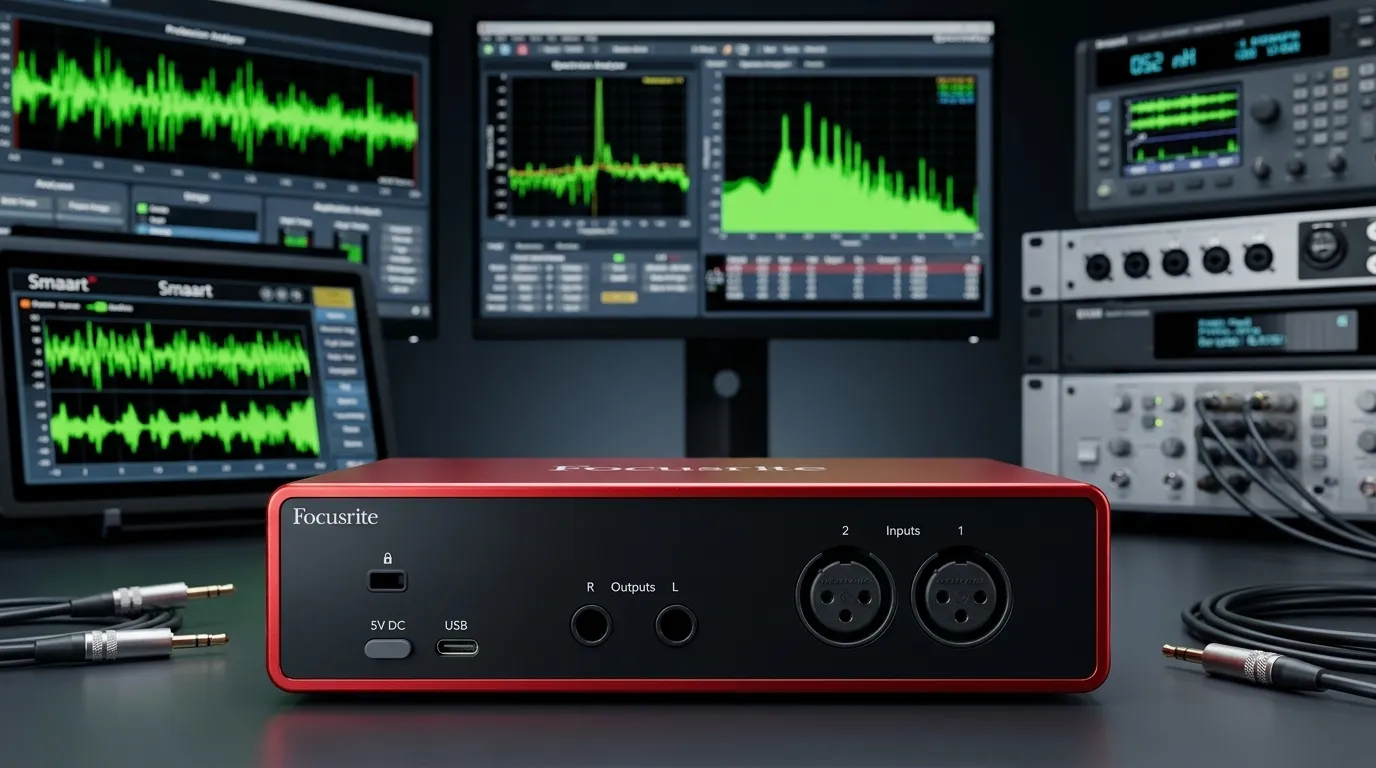
Focusrite claims they pulled the converters from their flagship RedNet range. This isn't just fluff. The 4th Gen 2i2 boasts a 120dB Dynamic Range on the line outputs and 116dB on the mic inputs.
- Why does this matter? It’s about the Noise Floor. When you’re recording a delicate fingerstyle guitar, you need to crank the gain. With a cheap interface, you’re just amplifying hiss. With 120dB of range, your "silence" actually sounds like silence.
The Preamp Gain (The SM7B Killer)
The 4th Gen preamps now offer 69dB of gain. Let that sink in. The 3rd Gen had 56dB. If you own a Shure SM7B or a low-output ribbon mic, you used to need a $150 Cloudlifter just to get a usable signal. With the 4th Gen 2i2, you can plug that SM7B straight in, crank the knob, and you’ll have plenty of clean headroom. This is a game-changer for the home studio market.
The Specs Table: 2i2 vs. The Giants
| Feature | Scarlett 2i2 4th Gen | Universal Audio Volt 2 | MOTU M2 |
|---|---|---|---|
| Max Gain | 69 dB | 55 dB | 60 dB |
| Dynamic Range | 120 dB (Out) | 113 dB | 115 dB |
| THD+N | -115 dB (DAC) | -110 dB | -110 dB |
| EIN | -127 dBu | -128 dBu | -129 dBu |
| Round-Trip Latency | ~5.8ms (96k/64 buff) | ~6.2ms | ~5.4ms |
The Stress Test: Tracking High-Transient Drums
I took this bundle into a live room to see if it could handle the "Rodrigo Stress Test": A high-SPL snare drum hitting the CM25 MkIII condenser mic, while the second input took a DI signal from a hot active bass.
The Result: The Clip Safe feature is legit. I purposely set the gain a bit too high and started whaling on the snare. You can actually hear the unit "smartly" pulling the gain back in real-time. It’s not a compressor; it’s an automated gain stage adjustment. It saved the take.
For the songwriter recording themselves, this is like having an assistant engineer sitting next to you. You can focus on the emotion of the take rather than staring at a meter.
The CM25 MkIII Mic: It’s an electret condenser. It’s "bright." In a professional environment, I might find it a bit "tizzy" in the 8kHz range, but for a songwriter bundle, it’s miles ahead of the generic plastic mics you find in other "all-in-one" kits. It captures enough detail to be usable in a final mix with some clever EQ.
Evolution: What Did They Actually Fix?
As an Amazon Associate I earn from qualifying purchases.
Focusrite finally listened to the Reddit and Gearspace "whiners" (of which I am often one).
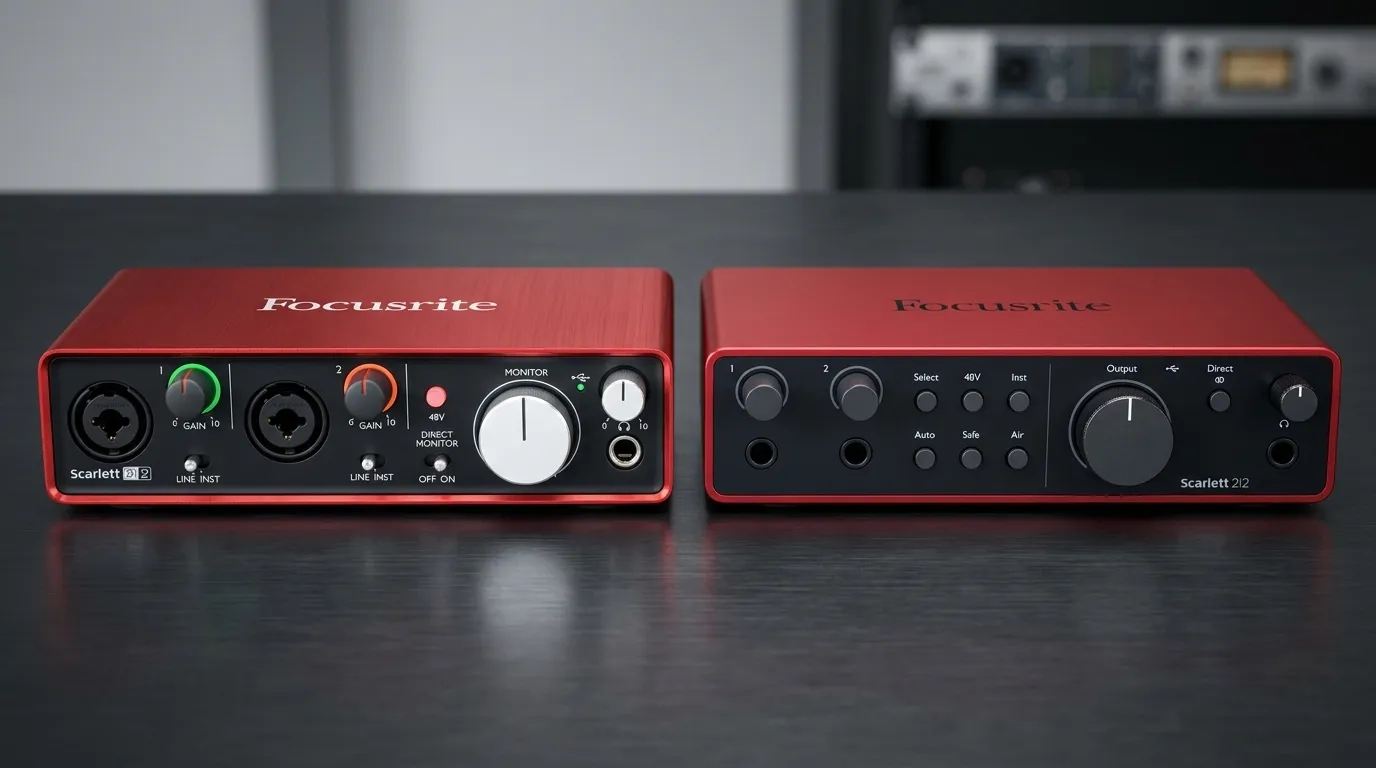
- Independent Volume Controls: On previous "Solo" and older "2i2" models, the monitor and headphone volume were sometimes tied or poorly implemented. Here, you have total control.
- Air Mode "Harmonic Drive": The old "Air" mode was just a high-frequency shelf. The 4th Gen adds a second "Harmonic Drive" mode that actually mimics the saturation of a console. Is it a Neve? No. But it adds a thickness to thin vocals that is genuinely useful.
- The Software Bundle: They’re still including the Hitmaker Expansion. Softube, Antares, and XLN Audio. This isn't "lite" bloatware; these are tools I actually use in my pro sessions.
Pros & Cons (The No-BS Reality)
Pros
- Massive Gain Range: 69dB means you don't need external boosters for dynamic mics.
- Industry-Leading Conversion: The 120dB dynamic range is unheard of at this price point.
- Clip Safe & Auto Gain: These features are a godsend for solo performers.
- Build Quality: It feels like a professional tool, not a consumer electronic.
- Hitmaker Expansion: The plugin bundle alone is worth half the price of the unit.
Cons
- The Headphones (SH-450): They are "okay." They’re closed-back and good for tracking, but I wouldn't trust them for a final mix. They lack the low-end translation of a pair of Sennheiser HD600s.
- USB 2.0: In 2026, I’d love to see a native USB 4 or Thunderbolt implementation for even lower latency, though for 2 channels, USB 2.0 is technically sufficient.
- Plastic Knobs (Inner): While the main dial is great, the smaller gain pots are still plastic-stemmed. Be careful with them in a backpack.
FAQ: People Also Ask
1. Is the Scarlett 2i2 4th Gen good for the Shure SM7B? Yes. Unlike the 3rd Gen, the 4th Gen has 69dB of gain. You no longer need a Cloudlifter or FetHead to get a clean, loud signal into your DAW .
2. Can I use the 2i2 4th Gen for podcasting? Absolutely. The "Loopback" feature makes it incredibly easy to route computer audio (like a Discord guest) into your recording software without complex virtual cabling.
3. Does the 4th Gen work with iPad? Yes, it is USB-C class compliant. It works perfectly with iPad Pro models, though you may need an external power supply for some older Lightning-based iPads.
4. What is the difference between "Air Presence" and "Harmonic Drive"? Presence boosts the high frequencies (the "shimmer"), while Harmonic Drive adds mid-range richness and saturation, mimicking an analog console.
5. Is the Scarlett Studio bundle worth it over buying the interface separately? If you are starting from zero, yes. The mic is solid and the cables are high-quality. If you already own a $500 mic and pro headphones, just buy the interface alone.
Stop Searching, Start Shipping
Listen to me. I see you. You’ve spent the last three weeks watching 50 different reviews, comparing THD numbers to the fourth decimal point, and wondering if "the next big thing" is around the corner.
STOP. The 2i2 4th Gen is better than the gear used to record Thriller. It is better than the gear used to record Nevermind. If you can't make a hit with 120dB of dynamic range and 69dB of clean gain, the gear isn't the problem. You are.
Buy the box. Plug in the mic. And for the love of everything holy, stop worrying about the specs and start worrying about the song. The 4th Gen is officially "pro enough" for anyone. Now go make some noise.

Rodrigo Marques
Rodrigo Marques, founder of Home Studio Start, is a music production veteran with over 25 years of experience. Since 1997, he has mastered tools like Sound Forge, Samplitude Pro, and VST plugins, producing albums for emerging artists globally. Creator of the innovative Formula HSS for mixing and mastering, Rodrigo has empowered thousands through online courses and his ebook, Home Studio Start. Dedicated to democratizing music production, he equips aspiring artists with skills for professional-grade music and sustainable careers.
About the author